
How to cut LLM API costs by 30–70% without switching to a weaker model
How to reduce LLM API costs: why the bill outgrows revenue, what going direct to each vendor really costs, and a verified cheaper path to the same models.
· 6 min read · OSMEXO team
LLM inference is billed per token, so the cost of an AI feature scales with how much it is used, not with what it earns. This post explains why that bill grows faster than revenue, which workloads are most exposed, what integrating each model vendor directly actually costs, and how to pay less for the same model without changing your code.
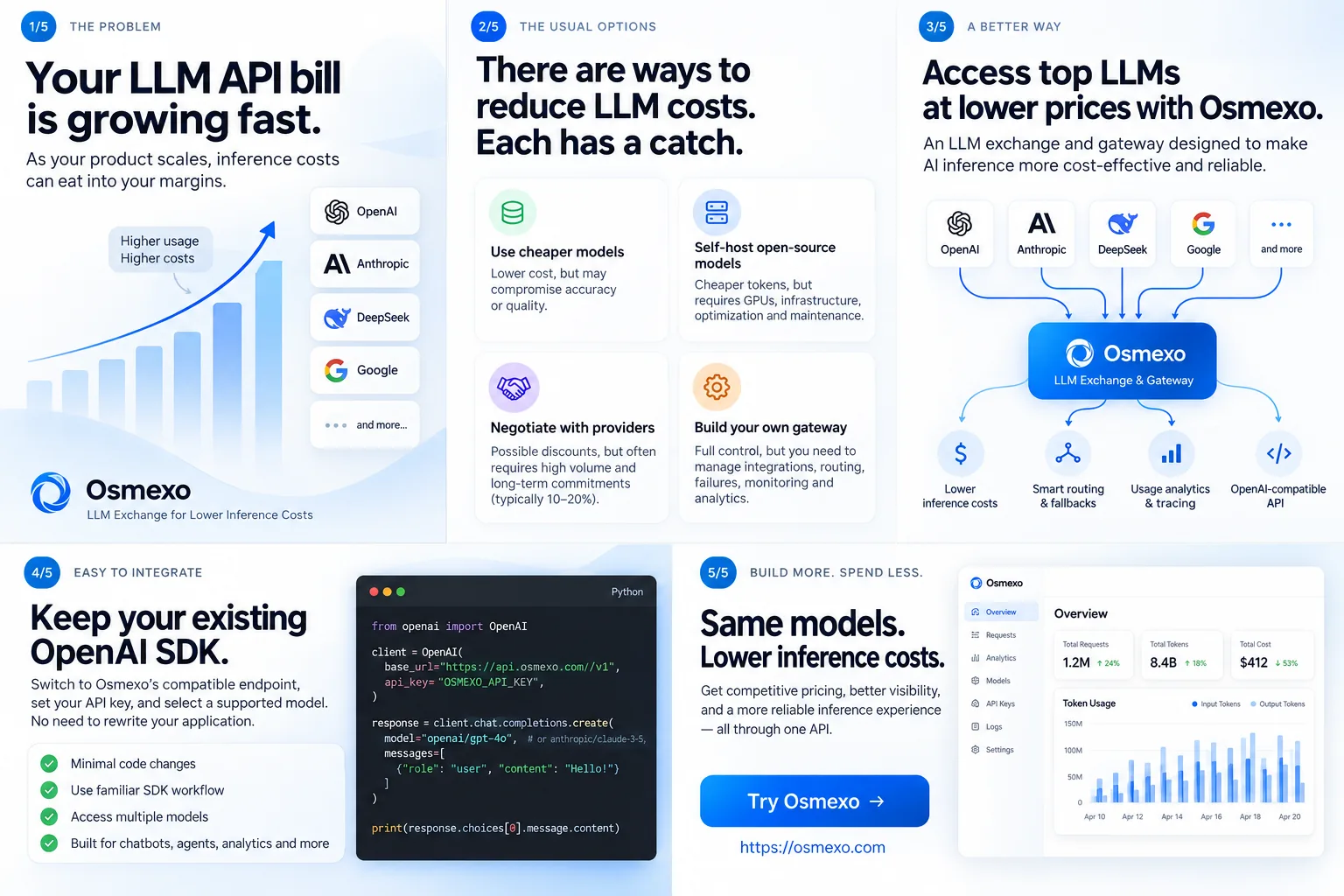
Inference cost scales with usage, not with revenue
- List price from the first token. There is no reserved pricing and no meaningful free tier. Until your volume justifies an enterprise agreement, the published rate is your rate.
- Frontier pricing rises with capability. Reasoning models bill for thinking tokens you never see, larger context windows invite larger prompts, and output tokens cost several times input tokens.
- Prompt caching has a narrow effect. It discounts the repeated prefix, usually the system prompt. The user message, retrieved context and conversation history are billed in full on every call.
A feature that costs $500 a month at launch costs $5,000 at ten times the usage, while the subscription price per customer stays where it was.
Workloads where inference dominates the cost base
- Extraction and analytics at scale. Classification, tagging and structured extraction run the same prompt across millions of records. There is no user to amortise against; the per-call price is the entire cost.
- RAG and document processing. Retrieved passages add thousands of input tokens to every prompt, and ingestion pipelines process whole corpora in batch.
- Customer support and conversational agents. Each turn resends the full history, so the cost of a conversation grows with the square of its length.
- Coding assistants and agent tooling. A single task issues dozens of calls over contexts of a hundred thousand tokens or more.
- Multi-step agent workflows. Planning, tool use, verification and retries multiply the calls per completed task.
- Seat-priced SaaS. Revenue is fixed per user while cost is variable per request, so the heaviest users carry negative margin.
Who should read this
- Engineering and finance leads at companies past product-market fit, where inference has become a line item that outgrows revenue.
- Agencies and studios operating AI features for several clients, each on separate vendor accounts and invoices.
- Small teams and independent developers outside the United States, for whom US-dollar card billing, minimum purchases and spend-tiered rate limits are a barrier to entry.
- Teams already running two or more vendors, including developers who configure a separate key per vendor in OpenCode, Cline, Roo Code, Continue or Aider.
The cost of integrating each vendor directly
Calling OpenAI, Anthropic or Google directly guarantees one thing nothing else can: the response comes from the vendor’s own deployment. Every other aspect carries a cost.
- List pricing. Volume discounts require a sales process and a committed spend. Below that threshold, every token is billed at the published rate.
- Duplicated administration. Each vendor means a separate account, API key, payment method, invoice, usage dashboard and usage policy. Finance reconciles several invoices; engineering distributes several keys across every tool.
- Rate limits tied to spend history. New accounts start at low requests-per-minute and tokens-per-minute tiers that rise with cumulative spend, not with demand. A launch spike is throttled on the day it matters.
- No failover. A vendor incident reaches your users as an error. Retry and reroute logic is yours to build and operate.
- Cost visibility arrives monthly, per vendor. Attributing spend to a feature, customer or key across vendors requires metering you build yourself.
- Model lifecycle on the vendor’s schedule. Deprecations and renames each require a migration, per vendor.
None of this argues against the models. It argues against integrating the vendors one at a time.
Four conventional answers and their trade-offs
- Use a smaller model. Adequate for simple tasks. For reasoning, long context or reliable tool calling, the saving is returned in evaluation effort and retries.
- Self-host open weights. Full control, plus GPU procurement, autoscaling, quantisation decisions, monitoring and on-call. Economical only at sustained, high volume.
- Negotiate with the vendor. Material discounts begin at commitment levels most teams cannot yet justify, and each vendor is negotiated separately.
- Build an internal gateway. Routing, retries, failover and metering form a product of their own, with permanent ownership. Aggregators such as OpenRouter remove the integration effort but not the price: list rate plus a margin.
An inference exchange: the same model at a lower price
The same frontier models are served by more than one provider, at different prices and with different spare capacity. An inference exchange sources each model from several providers, verifies that every route serves the model it claims, and dispatches each request to the cheapest verified route. OSMEXO is that exchange behind an OpenAI-compatible API, priced at or below list. Your SDK, model identifiers and prompts stay as they are; two configuration values change.
- OpenAI
- Anthropic
- DeepSeek
- Qwen
- Kimi
- GLM
- ElevenLabs
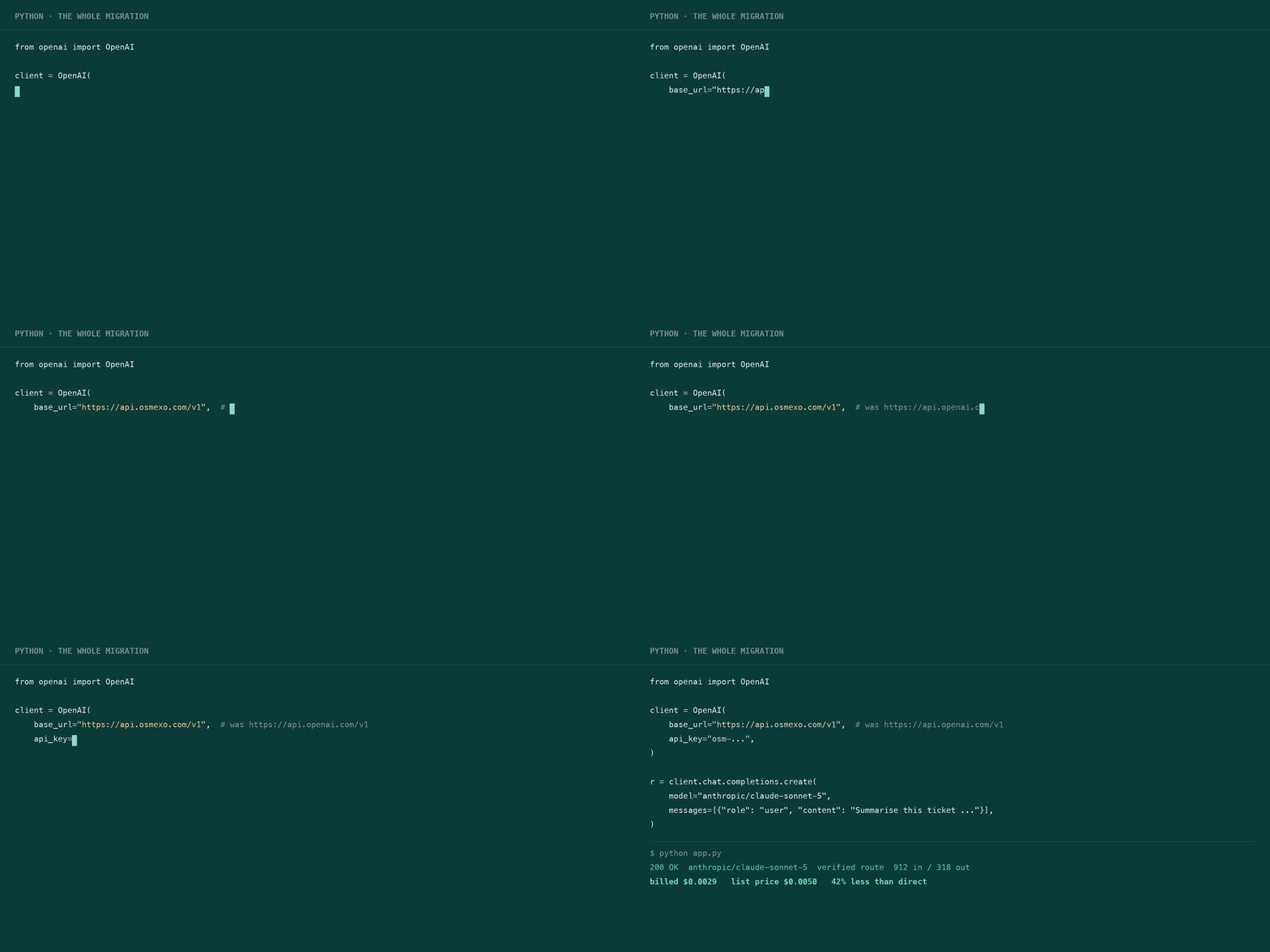
from openai import OpenAI

client = OpenAI(
    base_url="https://api.osmexo.com/v1",   # was https://api.openai.com/v1
    api_key="osm-...",                        # your OSMEXO key
)

r = client.chat.completions.create(
    model="anthropic/claude-sonnet-5",
    messages=[{"role": "user", "content": "Summarise this ticket ..."}],
)
Streaming, tool calls, structured output, vision, embeddings, image generation and speech behave as they do upstream.
| Direct with each vendor | With OSMEXO | |
|---|---|---|
| Accounts and keys to manage | One per vendor | One |
| Invoices | One per vendor, in several currencies | One prepaid balance |
| Price per token | List | List or lower |
| Volume discount | Negotiate with each vendor | Request per model in the dashboard |
| When a provider fails | Your users see an error | Automatic fallback to a verified route |
| Provider quality | You find out in production | Verified before it serves you |
| Cost visibility | Monthly, per vendor | On every response, per key |
| Payment | Card per vendor | PayPal, Visa or Mastercard, once |
| Coding agents | A key per vendor in each tool | One key; models marked Coding ready |
Current savings
96 models are callable today across 60 vendors over 134 verified routes. Most text models are priced 40 to 60 percent below the vendor’s list price; the best routes are 70 percent below the cheapest major gateway. Prices are checked daily against OpenRouter, DeepInfra, Novita and Together AI, and the comparison is published in full, including the models where OSMEXO is more expensive.
The live comparison, model by model against the other gateways’ published prices, is on the models page and in the dashboard under Compare.
Every live price, with the vendor’s list price alongside, is on the models page; the pricing page includes a calculator for your monthly volume.
A lower price only matters if it is the same model
A lower price under a model’s name proves nothing by itself: a route could be serving a quantised build or an older checkpoint. Two controls address that.
- Every route is probed before it serves traffic. A fixed battery runs against the route and against the vendor’s own API using our key: tokenizer fingerprint, knowledge cutoff, a hidden-prompt probe and exact-output tasks. Routes score 0 to 100; below 85 is not approved, and routes that drift are removed from rotation.
- You can run the same battery yourself with your own vendor key. Exit code 0 means the same model; 2 means a different one.
curl -fsSLO https://dashboard.osmexo.com/verify.mjs
OSMEXO_API_KEY=osm-... VENDOR_API_KEY=sk-ant-... node verify.mjs \
  --model anthropic/claude-sonnet-5 --vendor anthropic --vendor-model claude-sonnet-5
The tests and their weights are documented at docs.osmexo.com/verify. Coding-agent readiness is tested the same way: 58 models currently carry a “Coding ready” badge, and a model that fails the battery never shows it.
A cheaper path to the same model
OSMEXO is OpenAI-compatible only. If you hold an enterprise agreement that beats the published price for your main model, check the comparison first; the models where OSMEXO is more expensive are listed there too.
Start with one workload. Create a key, point the base URL at OSMEXO, and compare the cost reported on the first response with your vendor invoice. Prepaid from $5 by PayPal, Visa or Mastercard. No subscription; credits do not expire.
Frequently asked
- How much can I save on LLM API costs with OSMEXO?
- Most text models are priced 40 to 60 percent below the vendor’s list price and the best routes are 70 percent below the cheapest major gateway. The exact figure per model is on the models page, with the list price struck through beside it, and the pricing page has a calculator for your monthly token volume.
- Is it the same model as calling OpenAI, Anthropic or Google directly?
- Yes. Every route is probed against the vendor’s own API before it serves anyone: tokenizer fingerprint, knowledge cutoff, a hidden-prompt probe and exact-output tasks, scored 0 to 100 with 85 as the approval threshold. You can run the same check on your machine with your own vendor key from any model page in the dashboard.
- How is OSMEXO different from OpenRouter?
- Both give you one OpenAI-compatible API for many models. OSMEXO is an inference exchange, so it sources each model from several verified providers and prices it at or below list, and it publishes a daily comparison against OpenRouter, DeepInfra, Novita and Together AI, including the models where it is pricier.
- Do I need to change my code?
- Only the base URL and the API key. The gateway speaks the OpenAI wire format for chat, responses, embeddings, images, speech and transcription, so the official OpenAI SDKs and tools such as OpenCode, Cline, Roo Code, Continue and Aider work as they are.